 Chandigarh, Pathankot
 Office Hours : 09:30am - 6:30pm




AI Agents vs Chatbots: What’s the Difference?
Home » Uncategorized » AI Agents vs Chatbots: What’s the Difference?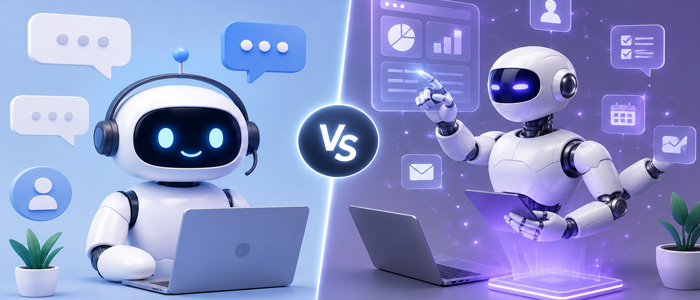
Artificial Intelligence (AI) has transformed the way businesses interact with customers, automate processes, and improve productivity. Among the most popular AI-powered technologies are chatbots and AI agents. While these terms are often used interchangeably, they are not the same. Understanding the difference between AI agents and chatbots is essential for businesses looking to leverage AI effectively.
In this article, we’ll explore what chatbots and AI agents are, how they work, their key differences, and which one may be the right choice for your organization.
What Is a Chatbot?
A chatbot is a software application designed to simulate human conversation through text or voice interactions. Chatbots are commonly found on websites, mobile apps, messaging platforms, and customer service portals.
Traditional chatbots operate based on predefined rules and scripted responses. They are programmed to recognize specific keywords, phrases, or commands and provide corresponding answers.
What Is an AI Agent?
An AI agent is a more advanced AI system capable of understanding goals, making decisions, taking actions, and learning from interactions. Unlike traditional chatbots that mainly respond to questions, AI agents can independently perform tasks to achieve specific objectives.
AI agents use a combination of technologies such as:
- Large Language Models (LLMs)
- Machine Learning
- Natural Language Processing
- Memory Systems
- External Tool Integration
- Decision-Making Frameworks
Rather than simply answering a question, an AI agent can analyze situations, plan steps, execute tasks, and adapt its behavior based on outcomes.
Common Uses of Chatbots
- Customer support
- FAQ assistance
- Appointment scheduling
- Lead generation
- Order tracking
- Basic troubleshooting
For example, if a customer asks, “What are your business hours?” a chatbot can instantly provide the correct answer from its database.
Modern AI-powered chatbots use Natural Language Processing (NLP) to better understand user queries and provide more conversational responses. However, they typically remain limited to specific tasks and predefined workflows.
Common Uses of AI Agents
- Business process automation
- Personal assistants
- Research and data analysis
- Workflow management
- Software development assistance
- Sales and marketing automation
- Financial analysis
For example, if you ask an AI agent to “Find the best suppliers, compare pricing, and prepare a summary report,” it can perform multiple actions autonomously to complete the task.
How Chatbots Work
Most chatbots follow a relatively straightforward workflow:
- User submits a query.
- Chatbot identifies keywords or intent.
- System matches the query with predefined responses.
- Response is delivered to the user.
Even AI-enhanced chatbots primarily focus on conversational interactions and usually operate within limited boundaries.
How AI Agents Work
AI agents go beyond simple conversation. They can:
- Understand objectives.
- Break goals into smaller tasks.
- Gather relevant information.
- Make decisions.
- Execute actions.
- Learn from outcomes.
For example, if a user asks an AI agent to plan a business trip, the agent may:
- Search for flights
- Compare hotel options
- Check schedules
- Create an itinerary
- Provide recommendations
All of these tasks can be performed with minimal human guidance.
Advantages of Chatbots
- Easy to implement
- Cost-effective
- Fast customer responses
- Available 24/7
- Ideal for repetitive inquiries
Advantages of AI Agents
- Autonomous decision-making
- Multi-step task execution
- Continuous learning capabilities
- Greater adaptability
- Increased productivity
- Reduced manual effort
Limitations of Chatbots
- Limited decision-making ability
- Struggles with complex requests
- Cannot perform multi-step tasks independently
- Often requires human intervention
Limitations of AI Agents
- More complex implementation
- Higher development costs
- Requires strong governance
- Potential security concerns
- Greater computational requirements
Key Differences Between AI Agents and Chatbots
| Chatbots | AI agents | |
| Purpose | Chatbots are designed primarily for conversation and customer interaction. | AI agents are designed to achieve goals and complete tasks autonomously. |
| Intelligence Level | Chatbots typically follow predefined scripts or limited AI models. | AI agents use advanced reasoning and decision-making capabilities to solve problems independently. |
| Task Complexity | Chatbots handle simple, repetitive tasks. | AI agents can manage complex workflows involving multiple steps and decisions. |
| Learning Ability | Many traditional chatbots do not learn from interactions. | AI agents can continuously improve through machine learning and feedback mechanisms. |
| Autonomy | Chatbots generally wait for user input before responding. | AI agents can proactively initiate actions and make decisions without constant human guidance. |
| Tool Integration | Chatbots often operate within a single platform. | AI agents can connect with databases, APIs, business software, CRM systems, and external tools to complete tasks. |
| Memory and Context | Most chatbots have limited conversational memory. | AI agents can maintain context across interactions and use stored information to make smarter decisions. |
Real-World Example
Imagine a customer asks: “I need help managing my monthly marketing campaign.”
Chatbot Response
A chatbot may:
- Provide links to marketing resources.
- Answer specific questions.
- Direct the customer to a support representative.
AI Agent Response
An AI agent may:
- Analyze campaign performance.
- Identify trends.
- Recommend improvements.
- Generate content ideas.
- Schedule social media posts.
- Create performance reports.
The chatbot provides information, while the AI agent actively works toward accomplishing the goal.
When Should Businesses Use Chatbots and AI Agents?
Chatbots are ideal when businesses need:
- Basic customer support
- FAQ automation
- Simple lead generation
- Appointment booking
- Order status inquiries
- Cost-effective customer service solutions
Small and medium-sized businesses often benefit greatly from chatbot implementation because of their simplicity and affordability.
AI agents are suitable when organizations require:
- Advanced automation
- Intelligent decision-making
- Workflow optimization
- Personalized customer experiences
- Complex task execution
- Data-driven insights
Large enterprises and technology-driven companies increasingly adopt AI agents to improve operational efficiency and reduce manual workloads.
The Future of AI Agents and Chatbots
The line between chatbots and AI agents is becoming increasingly blurred. Many modern AI solutions combine conversational interfaces with
agentic capabilities.
Today’s advanced systems can chat naturally like a chatbot while simultaneously performing tasks like an AI agent. This hybrid approach delivers better customer experiences and greater business value.
As AI technology continues to evolve, we can expect:
- Smarter virtual assistants
- More autonomous business operations
- Enhanced customer interactions
- Personalized AI experiences
- Increased workplace automation
Organizations that embrace these technologies early may gain significant competitive advantages.
While chatbots and AI agents both leverage artificial intelligence, they serve different purposes. Chatbots focus on communication and answering user questions, whereas AI agents are designed to reason, plan, make decisions, and complete tasks autonomously.
For businesses seeking simple customer engagement and support automation, chatbots remain an excellent solution. However, organizations looking to automate complex workflows, improve productivity, and achieve greater operational efficiency should consider implementing AI agents.
As AI continues to advance, the future will likely involve intelligent systems that combine the conversational abilities of chatbots with the autonomous capabilities of AI agents, creating more powerful and effective digital assistants than ever before.

 Get a Free Consultation






 S-6/4054, Dalhousie Road, Pathankot
